
Apple today previewed its iPhone 2.0 software, scheduled for release this June, and announced the immediate availability of a beta release of the software to selected developers and enterprise customers. The iPhone 2.0 beta release includes both the iPhone Software Development Kit (SDK) as well as new enterprise features such as support for Microsoft Exchange ActiveSync to provide secure, over-the-air push email, contacts and calendars as well as remote wipe, and the addition of Cisco IPsec VPN for encrypted access to private corporate networks.
The iPhone SDK provides developers with a rich set of APIs and tools (including programming interfaces for Core OS, Core Services, Media and Cocoa Touch technologies) to create native applications for iPhone and iPod touch. The iPhone SDK will allow developers to create applications that leverage the iPhone’s Multi-Touch user interface, animation technology, large storage, built-in three-axis accelerometer and geographical location technology to deliver truly innovative mobile applications.
Starting today, anyone can download the beta iPhone SDK for free and run the iPhone Simulator on their Mac. Apple today also introduced its new iPhone Developer Program, giving developers everything they need to create native applications, and the new App Store, a way for developers to wirelessly deliver their applications to iPhone and iPod touch users. The App Store enables developers to reach every iPhone and iPod touch user. Developers set the price for their applications — including free — and retain 70 percent of all sales revenues. Users can download free applications at no charge to either the user or developer, or purchase priced applications with just one click.
Source
Showing posts with label iPhone. Show all posts
Showing posts with label iPhone. Show all posts
Monday, March 10, 2008

Thursday, February 28, 2008
Apple shares rose more than 4% on optimism over iPhone demand
Shares of Apple Inc (AAPL.O) rose more than 4 percent on Thursday amid optimism on Wall Street that the maker of consumer favorites such as the iPod media player and iPhone can weather economic troubles.
The shares rose $5.46 to $128.42 in early trade on Nasdaq, a bright contrast to slumping broader markets weighed down by mounting U.S. recession fears.
The gains come one day after Apple affirmed its iPhone sales goal for this year and promised to give details of how outside programmers can create software for the device. The move is expected to spur demand for the Web-browsing and media-playing mobile phone.
Goldman Sachs analyst David Bailey, after a meeting with Apple Chief Operating Officer Tim Cook on Wednesday, said he continues to believe that "Apple's industry-leading product cycles should help it overcome softer seasonality and sets the stock up for a strong second half."
Although the shares have risen over the past two trading sessions, they are still a long way from recouping a 30 percent decline over the past three months. Investors have soured somewhat on Apple amid concerns that a slowing economy could hit sales of its Mac computers, iPods and iPhones.
Source
The shares rose $5.46 to $128.42 in early trade on Nasdaq, a bright contrast to slumping broader markets weighed down by mounting U.S. recession fears.
The gains come one day after Apple affirmed its iPhone sales goal for this year and promised to give details of how outside programmers can create software for the device. The move is expected to spur demand for the Web-browsing and media-playing mobile phone.
Goldman Sachs analyst David Bailey, after a meeting with Apple Chief Operating Officer Tim Cook on Wednesday, said he continues to believe that "Apple's industry-leading product cycles should help it overcome softer seasonality and sets the stock up for a strong second half."
Although the shares have risen over the past two trading sessions, they are still a long way from recouping a 30 percent decline over the past three months. Investors have soured somewhat on Apple amid concerns that a slowing economy could hit sales of its Mac computers, iPods and iPhones.
Source
Sunday, February 17, 2008
Smuggled iphone return to china

The strange journey of Apple’s popular iPhone, to nearly every corner of the world, shows what happens when the world’s hottest consumer product defies a company’s attempt to slowly introduce it in new markets.
The iPhone has been swept up in a frenzy of global smuggling and word-of-mouth marketing that leads friends to ask friends, “While you’re in the U.S., would you mind picking up an iPhone for me?”
These unofficial distribution networks help explain a mystery that analysts who follow Apple have been pondering: why is there a large gap between the number of iPhones that Apple says it sold last year, about 3.7 million, and the 2.3 million that are actually registered on the networks of its wireless partners in the United States and Europe?
The answer now seems clear. For months, tourists, small entrepreneurs and smugglers of electronic goods have been buying iPhones in the United States and then shipping them overseas.
Source
Friday, February 15, 2008
iPhone and Android are Internet clients
The iPhone and the Google Android platform, which was finally shown-off (sort of) in Barcelona this week, aren’t mobile telephones.
They are Internet clients.
Internet clients use exponentially more data bandwidth than ordinary digital phones, which use thin streams of compressed data. Maybe several exponentials.
Operators are thinking of expanding their networks into homes and offices to handle the extra load.
The Android clients shown in Barcelona aren’t much. What they mainly prove is that the specification can be built and deployed quickly.
While the Apple iPhone roll-out has gone at a predictable pace, with one vendor delivering specified numbers to a handful of networks, the Android roll-out will be far more helter-skelter.
That’s because the Android is designed to work anywhere, first on any GSM network and then, with a little tinkering, anywhere else
Source
They are Internet clients.
Internet clients use exponentially more data bandwidth than ordinary digital phones, which use thin streams of compressed data. Maybe several exponentials.
Operators are thinking of expanding their networks into homes and offices to handle the extra load.
The Android clients shown in Barcelona aren’t much. What they mainly prove is that the specification can be built and deployed quickly.
While the Apple iPhone roll-out has gone at a predictable pace, with one vendor delivering specified numbers to a handful of networks, the Android roll-out will be far more helter-skelter.
That’s because the Android is designed to work anywhere, first on any GSM network and then, with a little tinkering, anywhere else
Source
Friday, February 8, 2008
Apple chopdown the production of iPods, iPhones

Two research analysts have reported in recent days that Apple is aggressively cutting back production on iPods and iPhones, while increasing production on Mac computers.
Craig Berger, an analyst with FBR Research, told clients in a research note this week that Apple has reduced orders for iPhones and iPods for the second time in two months. Berger concludes that Apple is experiencing weak sell-through in the fourth calendar quarter of 2007 or in the early going this year.
"For both iPods and iPhones, we believe Apple was previously targeting a roughly 50 percent quarter-over-quarter decline for first quarter units, whereas we now think the firm is targeting a 60 percent quarter-over-quarter unit decline for first-quarter units," he wrote.
iPod Touch Weakness
It seems that the iPod Touch may have seen the weakest sales. Berger reported production orders for the Touch have fallen the most. The device may suffer from being less than an iPhone, since it has no phone capabilities but is substantially more expensive than Apple's music-playing iPhones. The touch relies on Wi-Fi for connectivity, so users who aren't in range of a Wi-Fi connection simply can't get online.
Source
Thursday, February 7, 2008
iphone: Review

From the moment Apple announced its iPhone at Macworld 2007, the tech world hasn't stopped asking questions. Because Apple has kept many iPhone details under wraps until very recently, we've been forced to speculate. Until now. Is the iPhone pretty? Absolutely. Is it easy to use? Certainly. Does it live up to the stratospheric hype? Not so much. Don't get us wrong, the iPhone is a lovely device with a sleek interface, top-notch music and video features, and innovative design touches. The touch screen is easier to use than we expected, and the multimedia performs well. But a host of missing features, a dependency on a sluggish EDGE network, and variable call quality--it is a phone after all--left us wanting more. For those reasons, the iPhone is noteworthy not for what it does, but how it does it. If you want an iPhone badly, you probably already have one. But if you're on the fence, we suggest waiting for the second-generation handset. Even with the new $399 price for the 8GB model (down from an original price of $599) and $499 for the 16GB model, it's still a lot to ask for a phone that lacks so many features and locks you into an iPhone-specific two-year contract with AT&T.
Design
On with the review: the iPhone boasts a brilliant display, trim profile, and clean lines (no external antenna of course), and its lack of buttons puts it in a design class that even the LG Prada and the HTC Touch can't match. You'll win envious looks on the street toting the iPhone, and we're sure that would be true even if the phone hadn't received as much media attention as it has. We knew that it measures 4.5 inches tall by 2.4 inches wide by 0.46 inch deep, but it still felt smaller than we expected when we finally held it. In comparison, it's about as tall and as wide as a Palm Treo 755p, but it manages to be thinner than even the trend-setting Motorola Razr. It fits comfortably in the hand and when held to the ear, and its 4.8 ounces give it a solid, if perhaps weighty, feel. We also like that the display is glass rather than plastic.
Source
Saturday, February 2, 2008
1.4 million missing iPhones not Really Missing, Says Analyst

Calculations that claim Apple Inc. is "missing" 1.4 million iPhones may be missing the point, according to an analyst, who said Monday that talk of uncounted phones overlooks the fact that the mobile market is only a small part of Apple's overall business.
"Stock analysts have been paying lots of attention to the iPhone numbers," said Ezra Gottheil, an analyst at Technology Business Research Inc., "and clearly the revenue [mobile service] providers give back to Apple affect profitability. But if you look at Apple, it's solidly profitable without the iPhone. The iPhone just takes it up to another level."
Gottheil was responding to calculations by Toni Sacconaghi, an analyst at Bernstein Research, that were widely reported last week. Sacconaghi used the 3.7 million iPhones reported sold by Apple and the 2 million activations cited by AT&T Inc. to conclude that about 1.4 million of the devices are either in inventory or have been unlocked.
"Some unknown number of iPhones are being unlocked by purchasers and some, probably a larger number, are being unlocked for resale," said Gottheil. "Some are in inventory. Some will be returned. And some are being used for the non-phone features, as iPhone Touches, until the owners can change their wireless contracts.
Source
Saturday, January 26, 2008
Missing iphones?
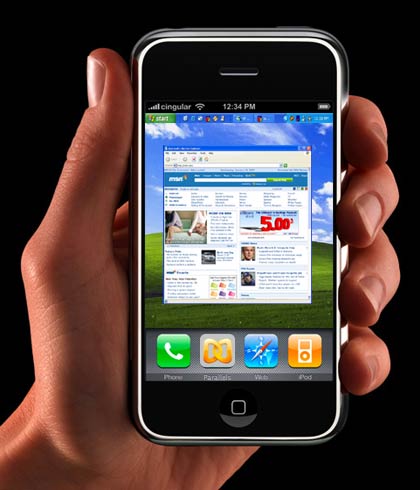
Shortly after Apple and its iPhone partner announced their financial results, the analysts noticed that there could be a little bit of problem. It seems like there are few hundreds of thousands iPhones roaming unaccounted on the market. Let’s see what happened!
Earlier this week, Apple announced that is has sold 3,7 million iPhones until the end of 2007. On the other hand AT&T, the exclusive distributor of iPhone in the US, revealed during its earnings conference call that it has ended the last year with “just at or slightly under 2 million iPhone customers”.
As you can imagine, the analysts immediately noted the discrepancy and has started to search the missing iPhones and some explanations. iPhone is available also in Europe, but there are no precise estimations of how many mobile phones have been sold so far.
were sold in UK, Germany and France or in other European countries. Orange, France Telecom’s mobile division, confirmed that the French users have bought 70,000 iPhone during the first month of availability, instead of 100,000 forecasted. The iPhone was launched in France on November 29. In UK, Telefonica’s O2 said that on track to sell 200,000 iPhones by early January. There no estimations for the iPhone sales in Germany, except a statement made by an official back in November. He said Apple sold 10,000 iPhone in the fist day.
Source
Subscribe to:
Posts (Atom)